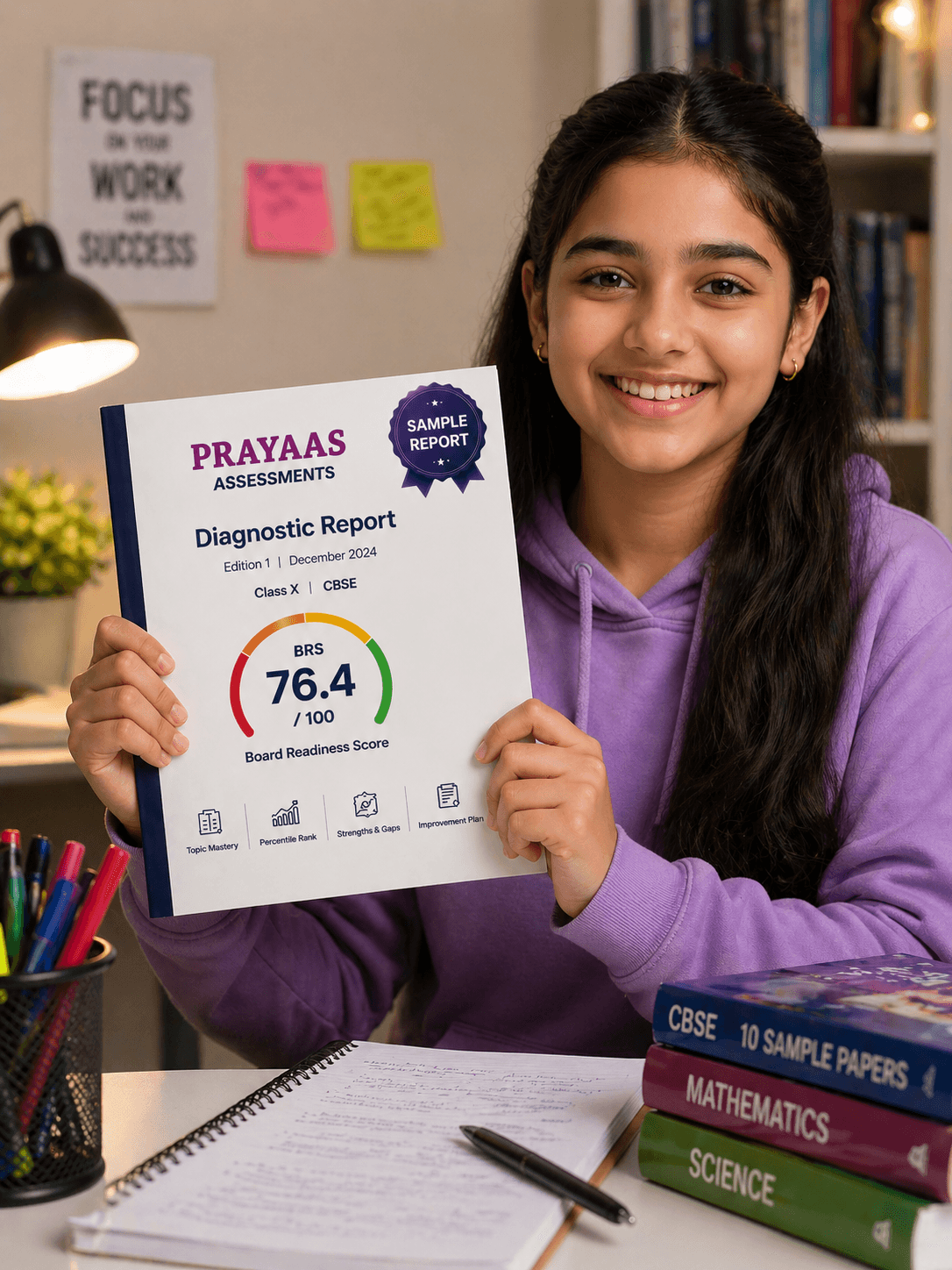
What is the Board Readiness Score? Readiness Score
A 100-point composite metric that interprets, not just reports, your child's CBSE board preparation. The methodology, the bands, and a sample calculation.
A 100-point composite that interprets, not just reports.
The Board Readiness Score (BRS) is a 100-point composite metric. It combines a CBSE student's mock board paper score, chapter-wise mastery distribution, and percentile placement against the cohort into a single, interpretable number that says how ready they are for the actual board examination.
A score is what a paper produces. The BRS is what a parent can act on. The difference is the interpretive layer - the BRS does not just tell you the marks; it tells you whether the marks reflect across-the-syllabus mastery or a few well-prepared chapters, and how the result places the student against a relevant cohort.
The Formula
How the BRS is calculated.
Mock Board Paper Score - 60% weight
The student's normalised score on the 80-mark mock board paper, scaled to 100. This is the highest-weighted component because it most directly mirrors what the boards measure.
Chapter-Wise Mastery Distribution - 25% weight
A normalised score (0 to 100) that rewards consistency across chapters and penalises lopsided performance. A student strong on five chapters and weak on seven scores lower than a student moderate on all twelve.
Cohort Percentile Placement - 15% weight
The percentile rank of the student against the same-class cohort in the same cycle. This is the smallest weight because peer performance is informative but not the primary thing to optimise for.
The weights (60 / 25 / 15) are reviewed after every cycle. The current weighting is v1.0 (April 2026); changes are documented in the methodology version log.
The Bands
What each BRS band means.
The BRS is reported as a single number, but every report places it in one of four named bands. The band is what tells parents how to spend the remaining weeks.
90 - 100
Boards-Ready
Strong command across most chapters. Focus the remaining time on exam timing, answer presentation, and revision of edge-case topics.
75 - 89
Approaching Ready
On the right track. Most chapters are in good shape; three to five chapters need focused work over the next four weeks.
60 - 74
Building Ready
Foundation is present, but there are visible gaps. Structured chapter-by-chapter revision is essential before exam-style practice scales up.
Below 60
Foundational Work Needed
Concept gaps in core topics. Spend the next several weeks on first-principles revision and small-paper practice rather than full mocks.
Worked Example
A sample BRS calculation walkthrough.
Consider a hypothetical Class XII student in the Edition 1 cycle. The student attempts the Mathematics mock board paper.
Step 1 - Paper Score
The student scores 62 of 80 marks on the mock board paper. Normalised to 100, that is 77.5.
Step 2 - Chapter-Wise Mastery
Across 12 chapters, the student shows 4 high-mastery, 6 medium-mastery, 2 low-mastery (no gaps, modest unevenness). The mastery distribution score is 71.
Step 3 - Cohort Percentile
Against the Class XII Mathematics cohort in Edition 1, the student is at the 73rd percentile.
The Composite
BRS = (77.5 × 0.60) + (71 × 0.25) + (73 × 0.15)
BRS = 46.5 + 17.75 + 10.95
BRS = 75.2 (Approaching Ready)
The student lands at the lower end of the Approaching Ready band. The roadmap section of the report names the two low-mastery chapters and recommends a four-week chapter-by-chapter focus, with two chapter tests per week.
FAQ
Common questions about the BRS.
What is the Board Readiness Score?
The Board Readiness Score (BRS) is a 100-point composite metric that interprets a CBSE student's mock board performance. It combines the mock board paper score (60%), chapter-wise mastery distribution (25%), and percentile placement against the cohort (15%) into a single, interpretable number.
How is the BRS different from the mock board score?
The mock board paper score is one input. The BRS is the full picture - it accounts for whether your child mastered the chapters across the syllabus (not just scored well on questions that happened to come up) and how the performance compares to the cohort. Two students with the same paper score can have different BRS values.
What is a good Board Readiness Score?
A BRS of 90 or above places a student in the Boards-Ready band - strong command across most chapters, ready to refine timing and presentation. 75 to 89 is Approaching Ready - on the right track, with three to five chapters needing focused work. Below 60 indicates foundational concept gaps that should be addressed before exam-style practice resumes.
Can the BRS predict my child's actual board score?
The BRS includes a predicted board percentage range based on present preparation, with a confidence interval. It is not a precise prediction - no instrument can predict a teenager's exact board score with certainty. The BRS gives an evidence-based range that helps parents and teachers plan the next four to twelve weeks of revision.
How often should a student check their BRS?
Once per cycle. Edition 3 runs in December 2026; Edition 4 runs in December 2027. The BRS is most useful as a periodic checkpoint, not a continuous metric. Students do daily and weekly practice via GoalKeepers; the BRS is the once-a-cycle full diagnostic.
Is the BRS the same for Class X and Class XII?
The composite formula is the same across classes, but the cohort changes. A Class X student is benchmarked against the Class X cohort; a Class XII student against the Class XII cohort. This is why the percentile placement component matters - it grounds the score in a relevant comparison.
The BRS is one part of a larger methodology that covers question-paper QA, examination integrity, evaluator training, and the diagnostic-tone discipline.
Read the full Prayaas methodology